
Heavy Duty Tow Straps
Dawnerz heavy-duty tow straps are designed exclusively for static traction, the safest extraction method for heavy machinery when applied with the correct technique and sizing. Manufactured from high-tenacity, low-stretch polyester (< 6% elongation), these straps provide the winch-style precision needed to utilize the raw torque of a recovery vehicle without the dangerous shock-loads that cause equipment failure.
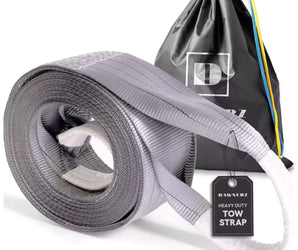 From $99.99 / Recovery Tow Strap - 70,000 lb Break Strength
 From $159.99 / Recovery Tow Strap - 85,000 lb Break Strength
 From $179.99 / Recovery Tow Strap - 100,000 lb Break Strength
 From $329.99 / Recovery Tow Strap - 180,000 lb Break Strength

Key Performance Benefits
Understanding Controlled Recovery
1. What Is Controlled Traction
Commercial and Industrial recovery is divided into two distinct techniques: Momentum and Traction, known in the consumer market as static and kinetic. Dawnerz recovery straps are designed specifically for the latter. Utilizing high-tenacity, low-stretch polyester, our straps allow the operator to use raw engine torque and tire traction for a "winch-style" pull that protects expensive machine frames.
2. Understanding Risk Mitigation
For loaded vehicles like dump trucks or aggregate haulers, momentum-based recovery "snatching" poses severe risks to load stability. A sudden jolt can shift unstable cargo or cause falling debris. Static mediums ensure the load remains stable and the recovery remains predictable, which is why Controlled Extraction is mandated on most industrial job sites.
3. Power-Matched Sizing
A professional recovery system is sized to the Source of Power, not just the weight of the stuck vehicle. The tension on your strap is dictated by the Maximum Drawbar Pull of the recovery vehicle. Matching the strap’s Break Strength to your machine's tractive effort, using a 3:1 or 5:1 safety factor, is industry standard for creating a balanced and safe recovery system.
Choosing the Correct Rating for Vehicle Recovery
| Drawbar Pull / GVW | Examples | Strap Size | MBS Strength | |
|---|---|---|---|---|
| Up to 23,333 lbs | 100-200 HP Tractors, Skid Steers | 4.7" / 2-Ply | 70,000 lbs | View |
| Up to 28,333 lbs | Medium Tractors, Telehandlers | 5.9" / 2-Ply | 85,000 lbs | View |
| Up to 33,333 lbs | Large Tractors, Combines | 7.1" / 2-Ply | 100,000 lbs | View |
| Up to 60,000 lbs | Dump Trucks, Excavators | 11.8" / 2-Ply | 180,000 lbs | View |
| Up to 126,666 lbs | 600+ HP Tractors, Mining Gear | 11.8" / 4-Ply | 380,000 lbs | View |
RECOVERY PROTOCOLS
DAWNERZ: THE RULES OF RECOVERY
Traction-based protocols for heavy machinery extraction.
Size to the Power Source
Match your strap to the Max Drawbar Pull of your recovery vehicle. A system is only as safe as the force being applied to it.
Apply the Correct Safety Factor
Use a 3:1 ratio for general agricultural and construction work. Step up to a 5:1 ratio for regulated mining or high-risk industrial sites.
Prioritize Soft Shackles
Use synthetic connections for all hookups. They are 80% lighter than steel and eliminate the risk of heavy metal projectiles if a point fails.
Rely on Low-Gear Traction
Let the tires and torque do the work. Static straps are built for a slow, steady "winch-style" pull that protects the machine's frame.
Inspect After Every Heavy Pull
Check for fiber-melt (glazing) or lateral cuts. If the strap has been pushed to its limit and shows structural change, decommission it immediately.
Never "Snatch" or Shock-Load
Static straps do not stretch like rubber bands. A running start creates a violent jolt that breaks parts. If you need momentum, you have the wrong tool.
Never Use Steel Shackles for Extractions
In high-tension recovery, steel is a liability. If a chassis point shears, a steel shackle becomes a lethal projectile. Stick to soft shackles.
Never Hook to Tow Balls or Hitches
Standard trailer hitches are for rolling loads, not 50-ton extractions. Always connect to a certified chassis recovery point or drawbar pin.
Never Stand Near the Tension Path
Energy is invisible until it's released. Ensure all crew members stay at a "Clear Zone" distance of at least 1.5x the length of the strap.
Never Guess the Resistance
Factor in mud-suction (stiction) and inclines. If the recovery vehicle is struggling, stop. Re-evaluate the setup before you exceed the system's Max Pull.
Recovery System Setup Guide
Scaling your recovery system to the limits of your machine.
| Rule | What to Check | Why it Matters |
|---|---|---|
| Rule 1 Match the Recovery Vehicle | Prioritise the strap sizing based on the recovery vehicles drawbar pull, not only the stuck vehicles GVW. | A recovery vehicle cannot exceed its own max pull. Sizing to the load leads to system imbalance. |
| Rule 2 Minimum 3x MBS | Your strap's MBS must be at least 3x the recovery vehicle's max drawbar pull. | Example: A 60,000 lb pull requires a 180,000 lb strap to maintain a safe working margin. |
| Rule 3 Assess the Terrain | Confirm the ground can support the weight and traction of the recovery vehicle. | Soft or unstable terrain risks getting the rescue vehicle stuck, compounding the recovery. |
Tow & Recovery Series: 70,000 lb - 380,000 lb MBS


Frequently Asked Questions
What is the difference between MBS and WLL?
Minimum Breaking Strength (MBS) is the force at which a new, undamaged strap is expected to fail under laboratory conditions. Working Load Limit (WLL) is the maximum mass or force that the strap is authorized to support in standard operations. At Dawnerz, we utilize a 3:1 or 5:1 Safety Factor to determine WLL, ensuring that the operational load never approaches the physical breaking point of the material.
How do I determine which Safety Factor (SF) to apply to my recovery?
The choice of Safety Factor is typically dictated by industry regulations or site-specific safety protocols.
- 3:1 Safety Factor: The professional standard for most agricultural, construction, and general commercial vehicle extractions.
- 5:1 Safety Factor: Often mandated for high-risk environments, including active mine sites, municipal recovery, and government infrastructure projects.Always consult your site’s safety officer or internal Risk Management Plan to ensure your recovery system meets the required threshold.
How do I find my vehicle’s Maximum Drawbar Pull?
Drawbar pull is the actual pulling capacity of your machine and is the most critical figure for system sizing. You can find this data through:
- Manufacturer Specifications: Most industrial and agricultural equipment manuals list peak tractive effort or drawbar pull.
- Nebraska Tractor Test Lab (NTTL): For agricultural machinery, the NTTL provides verified, independent drawbar benchmarks.
- The Weight Rule of Thumb: For tracked dozers or ballasted tractors on firm soil, drawbar pull often equals 70% to 100% of the machine's static weight.Note: Your recovery strap must be sized to the Power Source (Recovery Vehicle), as the system can never experience more load than that vehicle can pull.
Why does Dawnerz advocate for Static Recovery over Momentum-based "Snatching"?
In industrial extractions involving loaded or high-tonnage machinery, momentum is a safety liability. A kinetic "snatch" stores massive amounts of elastic energy that can result in violent recoil or damage to machine frames. Static recovery utilizing high-tenacity polyester (< 6% elongation) provides a "winch-style" pull. This ensures total operator control, maintains load stability for unweighted or shifting cargo, and protects the structural integrity of the chassis.
Does moisture or mud affect the strength of a Dawnerz strap?
No. Our straps are manufactured from industrial-grade Polyester (PES), which is naturally hydrophobic. Unlike Nylon, which can lose 20% to 30% of its tensile strength when saturated. Polyester maintains 100% of its rated MBS in wet, muddy, or frozen conditions.
Can I use these straps for vertical lifting or as a permanent tie-down?
No. While Dawnerz straps are manufactured to WSTDA and EN 1492 manufacturing standards (the same used for lifting slings), they are engineered and labeled specifically for vehicle recovery and towing. Using a recovery strap for overhead lifting is a violation of OSHA safety standards. For tie-down applications, utilize dedicated transport-rated webbing.
When should a recovery strap be decommissioned and retired?
Equipment must be inspected before every pull. You must retire the strap immediately if you identify:
- Lateral cuts or deep abrasions that compromise the outer webbing fibers.
- "Heat Glazing" or shiny, melted patches caused by previous shock-loads.
- Significant UV fading or chemical staining from acids, oils, or grease.
- Distorted or frayed connection eyes.If a strap has been subjected to a pull that exceeded its rated WLL, it should be thoroughly inspected for permanent elongation before being returned to service.
