
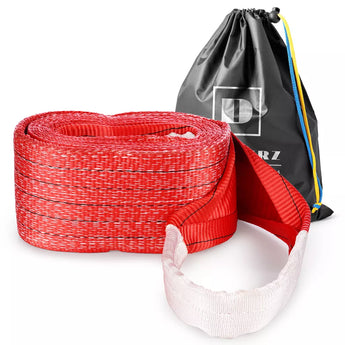


Heavy Duty Tow Strap - 2 Ply 85,000 lb MBS
Need a formal quote for your purchase? Request a quote.
Couldn't load pickup availability
CALIFORNIA PROP 65: WARNING
PROP 65: WARNING: This product can expose you to chemicals which are known to the State of California to cause cancer and/or birth defects or other reproductive harm. For more information, visit www.p65warnings.ca.gov
Product Information
Dawnerz 85,000 lb tow straps are designed for heavy-duty towing and recovery of medium tractors, telehandlers, agricultural machinery, support vehicles, and buses. Manufactured from high-strength polyester webbing, they provide low stretch and resistance to water, acid, oils, grease, and saltwater for demanding agricultural and commercial recovery applications.
The 85,000 lb tow strap provides an 85,000 lb Minimum Breaking Strength (MBS) and a 28,333 lb Working Load Limit (WLL) based on a 3:1 safety factor. Available in 20 ft and 30 ft lengths, the 20 ft option is suited to controlled towing and shorter connections, while the 30 ft option provides additional working distance for field recovery and soft-ground conditions.
Each Dawnerz tow strap has clearly marked product identification and safety information showing the strap capacity and applicable working load limits.
- Designed for towing, vehicle recovery, and winch line extensions when additional reach is required.
- Low-stretch polyester webbing provides a more controlled connection during towing and recovery applications.
- Lightweight construction rolls easily for one-person handling, deployment, positioning, and storage.
- Flexible webbing is easy to position around recovery points, equipment, and other connection points.
- Oversized reinforced eyes accommodate larger or awkward connection points during towing and recovery.
- Polyester webbing resists acid, oils, grease, and saltwater while maintaining its strength in wet conditions.
All products purchased directly from Dawnerz are covered by a 12-month warranty against manufacturing defects. The warranty does not cover damage caused by misuse, improper application, normal wear or external factors.
For complete warranty terms, visit our Warranty Information page.
Care & Inspection
Care & Storage Tips
- Rinse with clean water after use in mud, dirt or saltwater
- Inspect the strap before each use for cuts, fraying, abrasion, chemical damage or excessive wear
- Inspect the webbing and reinforced eyes for cuts, fraying, stitching damage or other visible deterioration
- Allow the strap to dry completely before storage
- Store in a clean, dry place away from direct sunlight, heat, chemicals and sharp objects
When to Replace
- Remove from service if the webbing has cuts, tears, severe abrasion, fraying or other visible damage
- Replace if the strap shows chemical damage, burns, melting or heat damage
- Do not use if the reinforced eyes or stitching are damaged or excessively worn
- Remove from service if it has been subjected to loads above its rated WLL or experienced severe shock loading.
- Do not use if the product identification or safety markings are missing or illegible
Recently viewed
FAQs - Shipping & Returns
Do you offer free shipping?
Yes, we offer free shipping on all orders, regardless of order value. Free shipping is available throughout the Continental U.S.
When will my order ship?
Orders are typically processed and shipped within 2-3 business days. Once your order ships, you'll receive tracking information by email.
How long will delivery take?
Delivery times vary by destination and shipping method. Your estimated delivery date is shown in your tracking data.
What is your return policy?
Unused products can be returned within 30 days of delivery, subject to our return policy. Products that have been used are not eligible for return.
Need Help Choosing the Right Product?
Contact Dawnerz

