
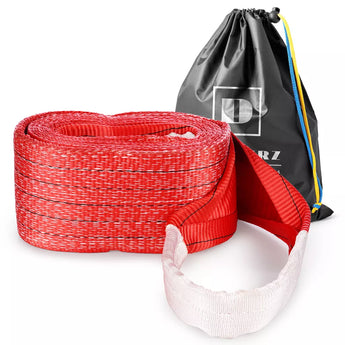


Heavy Duty Tow Strap 85,000 lb Break Strength for Combines, Service Trucks, and Telehandlers
- Minimum Breaking Strength: 85,000 lbs
- Working Load Limit (WLL 3.1): 28,333 lbs
- Working Load Limit (WLL 5.1): 17,000 lbs
- Class 7 Polyester Webbing
- Multi-use: Towing, Recovery, Winch-lines
Couldn't load pickup availability
|
From 2 units
−5%
From 10 units
−8%
From 20 units
P.O.A
|
Volume Discount Available
Request a Quote
|
Product and User Safety Information
Suitable Vehicle Types
- 200–250 HP Tractors
- Medium Combines
- Agricultural Recovery
- Service Trucks
- Telehandlers
For vehicles with a drawbar pull / GVW of upto 23,333 lbs
Product Description
85,000 lb MBS Tow / Recovery Strap
Medium-duty recovery operations require a balance between capacity and control. Oversizing introduces unnecessary weight, while undersizing increases system risk.
This 85,000 lb tow strap is matched to medium tractors and telehandlers, aligning with drawbar pull ranges typically between 18,000 and 26,000 lb. The 28,333 lb working load limit ensures the strap operates within a controlled and predictable range.
Using polyester webbing allows operators to apply steady pulling force without relying on momentum. This approach keeps recovery controlled and reduces stress on both machines and connection points.
Compared to steel cables or chains, the strap is significantly easier to handle and faster to deploy, making it suitable for both field and fleet operations.
Technical Specifications
Key Features
- Built for medium tractors, telehandlers, and service trucks
- 28,333 lb working load limit for balanced recovery setups
- Low-stretch polyester maintains steady traction under load
- Designed for controlled towing and winching applications
- Easier handling and faster deployment than steel alternatives
Shipping & Returns
- We cover standard shipping on all orders.
- Expedited shipping options are available at checkout for an additional fee.
- Orders are processed and shipped within 3–5 business days.
- 30-day returns available on eligible items, subject to standard return conditions
85,000 lb tow / recovery straps
Tow Strap Selection & Application Guide
Match Your Tow Strap To The Job
Dawnerz tow straps are designed for controlled static recovery. Correct selection is based on required drawbar pull (DBP), you need enough power to free the stuck vehcile. The goal is controlled force without overload or instability.
Why PES (Polyester Webbing)
Polyester tow straps are suited for controlled transfer with minimal stretch under load. This ensures predictable and stable performance in variable environments, and reduces the risk of rebound or uncontrolled energy release during recovery.
Towing Immobilised Vehicles
Used when a vehicle or machine cannot move under its own power due to mechanical failure. Applications include broken-down vehicles, immobilised agricultural equipment, and controlled movement on stable ground.
Loss-of-Traction Recovery
Used when a vehicle is functional but immobilised by terrain conditions such as wet grass, soft sand, or light mud. Recovery requires slow, progressive build-up to overcome resistance without introducing shock loading.
Winch Line or Extension Line
Used to bridge the gap when your winch cable can’t reach the anchor. It extends your recovery range while maintaining a straight, stable line of pull. This ensures your winch delivers its full force directly to the load without the instability caused by poor angles or limited reach.
Traction Based Recovery
Used when a vehicle is stuck and needs controlled pulling force to recover it. Common situations include soft ground, mud, sand, slopes, or heavy load resistance. Recovery requires steady, controlled tension to bring the vehicle back into motion safely.
THE PROCESS
How Static Recovery Works
Static tow straps are designed for controlled, low-stretch recovery. Force is applied steadily and directly to move the vehicle without sudden loading or snap-back.

Position & Setup
Select a recovery vehicle with sufficient pulling power. Ensure ground conditions can support the recovery vehicle.

Secure Connection
Attach the strap to rated recovery points on both vehicles. Keep the strap straight and remove slack before applying load.

Controlled Pull
Apply steady, gradual force to bring the vehicle into motion. Avoid jerking, snapping, or sudden acceleration.

Maintain Movement
Keep consistent tension until the vehicle is fully recovered. Do not introduce shock loads during the pull.
Recommended Products
85,000 lb Strap FAQs
Which vehicles are each strap suited for?
Use the strap that matches your recovery machine’s drawbar pull, not the weight of the stuck vehicle. Here’s a practical breakdown:
- 70,000 lb MBS – Smaller tractors, skid steers, compact telehandlers, farm service trucks. Drawbar pull up to ~16,000 lb.
- 85,000 lb MBS – Medium tractors, telehandlers, agricultural support vehicles, service trucks. Drawbar pull ~18,000–26,000 lb.
- 100,000 lb MBS – Large tractors, combines, bucket trucks, medium construction machinery. Drawbar pull ~27,000–33,000 lb.
- 180,000 lb MBS – Heavy construction machinery, large agricultural tractors, municipal trucks. Drawbar pull ~50,000–70,000 lb.
- 380,000 lb MBS – Ultra-heavy equipment, industrial dozers, large mining vehicles. Drawbar pull ~100,000+ lb.
This ensures each strap operates within its working load limit (WLL) and provides controlled, predictable recovery.
How should I size a strap correctly?
Always size to the recovery vehicle’s pulling capacity, not the stuck vehicle’s weight. A strap should never experience more load than the machine can generate. This keeps the recovery controlled, prevents strap damage, and maintains safety margins.
Can I use it for dynamic or kinetic recovery?
No. All Dawnerz tow and recovery straps are designed for controlled, static pulling. Avoid rapid, elastic pulls, as these generate forces exceeding the strap’s rated strength and increase the risk of failure.
Why use polyester instead of nylon?
Polyester minimizes stored energy compared to nylon, giving a steady, predictable pull. It reduces stress on both the recovery vehicle and connection points, allowing operators to maintain precise control during recovery.
Are these straps safer than chains or steel cables?
Yes. Polyester straps are lighter, easier to handle, and do not snap violently if they fail. Chains and steel cables carry higher risk in field deployments due to recoil and heavy weight. Straps also reduce fatigue and speed up setup.
What safety considerations should I follow?
- Always match MBS to drawbar pull.
- Inspect straps before each use for wear, abrasion, or damage.
- Protect straps from sharp edges or corners to avoid premature failure.
- Never use straps for lifting, they are intended strictly for towing and recovery.


